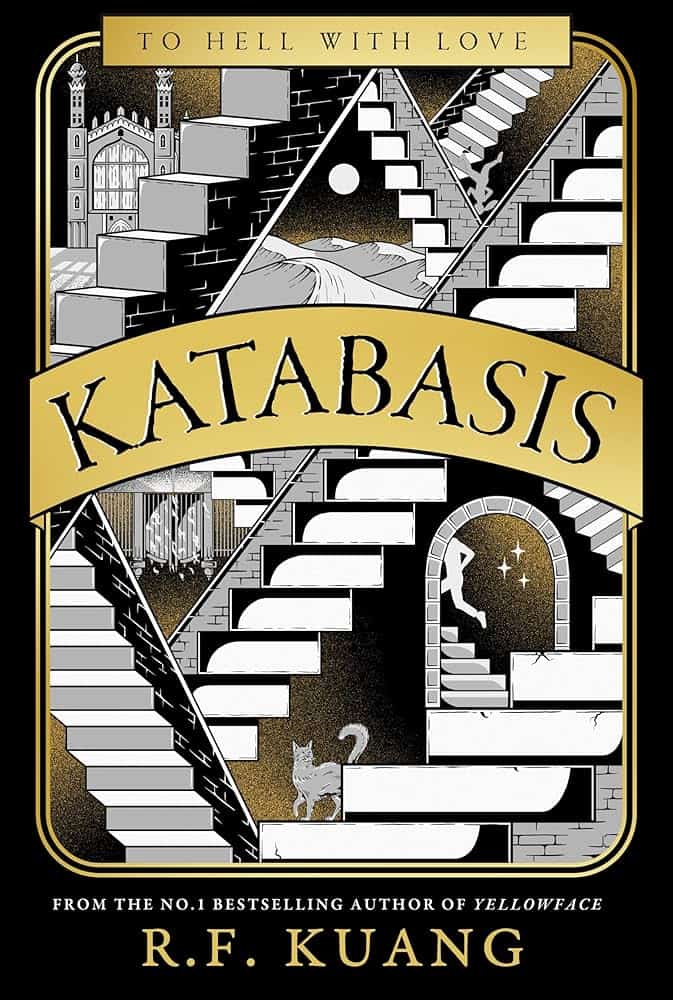
Katabasis
R.F. Kuang
There are novels about ambition, and then there are novels that ask what ambition costs. R.F. Kuang’s Katabasis belongs firmly to the latter category. An instant #1 Sunday Times bestseller, Katabasis arrived with the kind of momentum most literary fantasies can only hope for. But commercial success is only part of the story.
Following the cultural aftershocks of Babel and Yellowface, Kuang has become one of the most incisive chroniclers of institutional power writing today. With Katabasis, she turns her attention inward once more, this time to the rarefied, brittle world of Cambridge academia. The result is a dark academia fantasy that blends mythology with biting academic satire, sending the two postgraduate rivals quite literally into hell.
If that premise sounds dramatic, it is. But, like Kuang’s previous work, the spectacle is never the point. Katabasis is less concerned with demons and damnation than with the slow erosion of self that occurs when intellectual striving becomes identity.
At the centre of Katabasis are Alice Law and Peter Murdoch, Cambridge graduate students whose rivalry has long defined them. Brilliant, competitive, and chronically under-validated, they orbit the same sun: their formidable advisor, Professor Jacob Grimes.
When Grimes dies in a grotesque laboratory accident, his body shattered, and his soul queued for judgement, Alice and Peter are faced with an uncomfortable truth. Without him, their futures may be just as fragmented. Determined to retrieve him from the underworld, the rivals embark on a literal katabasis, a journey downward in the ancient mythic tradition of Orpheus.
This is a novel that believes in ideas – just not the cages we build for them.
- The Guardian
Kuang draws heavily on this classical lineage. The underworld of Katabasis is not merely a landscape of fire and punishment, but a labyrinth of bureaucracies, hierarchies, and trials that echo the institutional structures left behind in Cambridge. The descent becomes both a mythic quest and academic satire, a journey that exposes not only the afterlife but the warped logic of intellectual devotion.
As in Babel, Kuang demonstrates an acute understanding of how elite institutions shape those within them. The grind of postgraduate life is rendered with uncomfortable clarity: the endless pursuit of validation, the precariousness of funding, the quiet terror of irrelevance. Academic prestige functions as both a carrot and a cage. Success is dangled perpetually out of reach, ensuring that striving never ceases.
What makes Katabasis particularly compelling is its focus on the mentor-student relationship. Professor Jacob Grimes is not merely a supervisor; he is an institution unto himself. Rapacious, scornful, and addicted to his own myth, he has trained Alice and Peter to equate cruelty with excellence. His approval is scarce and therefore priceless. His silence wounds more deeply than rebuke.
Kuang understands the particular alchemy of academic power: how mentorship can slide into manipulation, how validation becomes currency, how young scholars internalise the extractive logic of the system that exploits them. In doing so, she exposes a truth many academics will recognise: that devotion to scholarship can blur into devotion to a person, and that such devotion can be both sustaining and corrosive.
In Katabasis, we’re once again treated to the power of Kuang’s mind. It takes a smart person to write geniuses, and Alice and Peter are brilliant, if blinkered
- The LA Times
Yet Katabasis is not without warmth. Alice and Peter’s antagonism is one of the novel’s sharpest pleasures. They have been taught to view one another not as allies but as obstacles, competitors for the same shrinking pool of funding, praise, and permanence. In hell, stripped of Cambridge’s architecture, that rivalry begins to look less like strength and more like damage.
The romance that flickers between them feels less like a genre concession and more like a rebellion against the logic that has shaped them. Instead, it underscores it. In hell, as in academia, intimacy becomes both refuge and risk. To love someone is to expose one’s vulnerabilities, and in a world built on competition, vulnerability can feel like weakness.
For some readers, this blend of academic jargon, mythic allegory, and slow-burn emotional development will be intoxicating. Her prose is sharp, often sardonic, but threaded with sincerity. She understands the allure of academia even as she dismantles it.
For others, the novel’s density may prove challenging. At 550 pages, Katabasis is unapologetically expansive. It lingers in philosophical debate. It revels in surreal, often disorienting sequences within the underworld. Kuang does not simplify her ideas for the sake of pace. Instead, she trusts her readers to follow her through corridors of theory and metaphor alike.
That willingness to demand attention is, in many ways, the novel’s strength. Kuang has always been interested in systems. In Katabasis, she turns the spotlight on the ivory tower itself, asking what it means to devote one’s life to knowledge within institutions that commodify it.
The characters are fully developed and painfully relatable.
- The Everygirl
Given its theatrical scope and vividly imagined underworld, it is perhaps unsurprising that an adaptation is already in development. Amazon MGM Studios has announced a series helmed by Angela Kang, known for her work on The Walking Dead. As of late 2025, the project remains in early development, with no casting confirmed. The potential is obvious: the visual spectacle of the underworld, the claustrophobic grandeur of Cambridge, the charged dynamic between rivals.
For readers who relish dark academia, who found themselves haunted by Babel, or who are drawn to fantasies that prioritise ideas over action, Katabasis will prove richly rewarding. It is not a breezy adventure, nor is it a straightforward romance. It is a novel that asks to be lingered over, argued with, and considered. For those willing to descend with it, the journey is as unsettling as it is illuminating.
Other works by R.F. Kuang
If Katabasis leaves you reflecting on the cost of ambition and the systems that shape it, Kuang’s earlier novels offer equally incisive examinations of power and identity:
- Babel (2022)
- Yellowface (2023)
- The Poppy War trilogy (2018 – 2020)
Discover more genre-spanning fiction with Victoria Freudenheim
If you love stories that interrogate worlds while creating them, explore our fantasy reviews, where imagination meets critique.
Or, if you’re in the mood for something different, browse our latest reviews across thrillers, crime, contemporary, and romance. Each is chosen for its depth, craft, and capacity to stay with you long after the final page.
And visit our blog, where we consider the habits, traditions, and quiet pleasures that make a life with books so enduring.
| ISBN | 978-0008501907 |
|---|---|
| Pages | 560 |