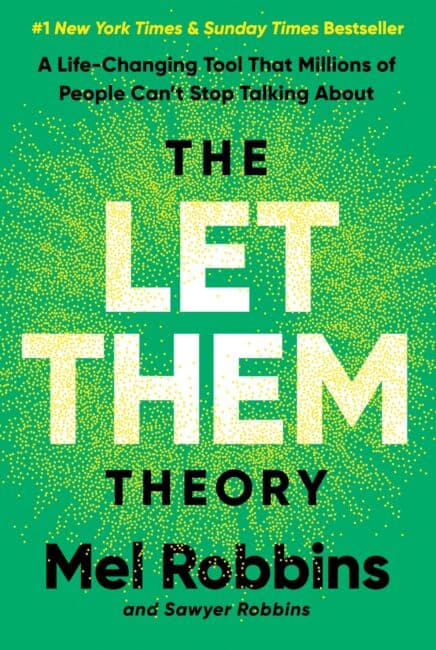
The Let Them Theory
Mel Robbins
Some ideas go viral because they’re complex and groundbreaking; others catch on because they’re impossible to forget. The “Let Them” Theory definitely belongs to the latter category. What started as a viral mantra has evolved into a global framework for emotional freedom. Though the book arrived in late 2024, the philosophy was already in motion by then. Today, it remains a staple of the modern psyche, because it just makes sense.
The premise is simple enough and direct. When confronted with behaviour you cannot influence, let them. Instead of reacting, overanalysing, or attempting to intervene, you accept the action and shift focus back to yourself. In her book, Mel Robbins pairs this with a second step, “let me”, reinforcing that acceptance is the only starting point. The aim is not withdrawal, but redirection. If you can’t dictate what others do, you can decide on how you respond. This works because it interrupts a very specific habit: the tendency to fixate on other people’s choices.
Much of the book is built around recognisable situations like being overlooked, dealing with difficult relationships, and navigating minor frustrations, where the natural instinct is to react emotionally or try to regain a sense of authority. By offering a simple, repeatable response, Robbins creates a pattern that can be applied almost immediately.
“The Let Them Theory has helped me prioritise what’s most important, reduce negative thoughts, and take action on the million things on my Really Want To-Do List.”
- The Midst
That immediacy is the book’s biggest strength. It is practical, memorable, and easy to implement without too much effort. Readers do not need to absorb complex frameworks or long explanations. The phrase itself does most of the heavy lifting. This is also what makes it so shareable. It easily fits into conversations, social media, and everyday language in a way that few self-help concepts have managed to in the past.
However, it’s that same simplicity that limits how far the book can go. Much of what Robbins presents echoes established ideas found in stoicism, cognitive behavioural techniques, and broader discussions around acceptance and personal agency. The book does acknowledge this, but rarely builds upon this further. Instead, it expands laterally, applying the same core idea to different scenarios rather than deepening it.
“The Let Them Theory is refreshingly real and a must-read if you’re craving a lighter way to live.”
- Notes by Thalia
There are also moments where the concept begins to feel stretched. The central message remains consistent, but its repetition across chapters can make sections feel interchangeable. The core insight is clearly established early on, and while many of the examples reinforce it, they rarely shift the reader’s understanding in a meaningful way. For some, this will feel reassuring. For others, it may feel like the book is circling a point that has already been made.
Where The Let Them Theory stands out is in how effectively it translates into behaviour. While the idea itself is not new, its clever reframing makes it easier to act on. Something which significantly appeals in the age of social media. It removes the friction that often comes with more complex self-development advice. The result is less about learning something new and more about applying something you likely already understand, but have not practised.
“The concept, made popular by self-help guru Mel Robbins, is a reminder that we can’t control others’ actions.”
- The Guardian
Robbins is also careful to define the theory’s boundaries. She clearly points out that it is not intended to excuse harmful behaviour or discourage intervention where it is needed. Nor is it a substitute for setting boundaries or advocating for yourself. Instead, it operates within a narrower space, addressing the moments where influence is assumed but ultimately unavailable.
The book’s impact, then, is tied less to originality and more to execution. It succeeds in turning a familiar principle into something usable. It may not offer much that is new, but it packages its message with enough clarity and precision to make it stick. More importantly, it lowers the barrier to change, giving readers something to which they can easily apply without overthinking it. For many, that kind of everyday practicality will prove its lasting value and will be its greatest strength.
Other works by Mel Robbins
If The Let Them Theory resonates, Mel Robbins’ wider work is also rooted in behaviour change and practical mindset shifts for you to explore and continue the journey into this area of self-help:
- Stop Saying You’re Fine (2011)
- The 5 Second Rule (2017)
- High 5 Habit (2021)
Discover more non-fiction with Victoria Freudenheim
If The Let Them Theory has you reflecting on mindset, behaviour, and everyday decision-making, explore our reviews across non-fiction and psychology, where practical ideas meet real-world application.
Or, if you’re in the mood for something completely different, why not browse our latest reviews across thrillers, mystery, romance, and contemporary fiction. For more book-related inspiration, remember to keep up to date with the Victoria Freudenheim blog.
| ISBN | 978-1788176651 |
|---|---|
| Pages | 311 |