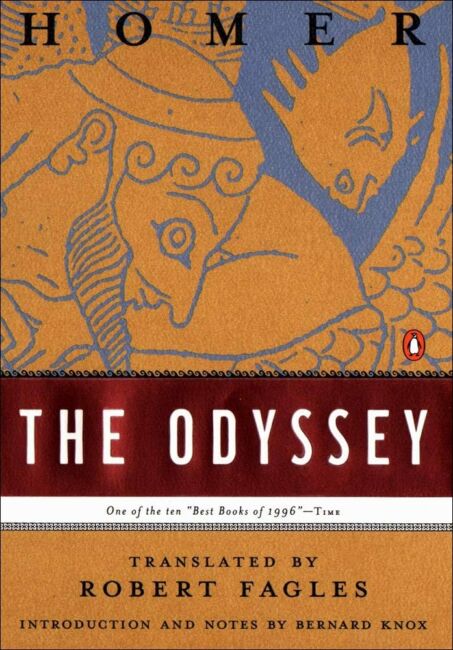
The Odyssey
Homer
Of all of the stories we have reviewed, this is by far the oldest. We have to admit, there is something quite surreal about discussing a poem that’s over 3,000 years old in the same breath as viral TikTok reads. But here we are. Homer could never have imagined what The Odyssey would share shelves with.
This original epic title is the salt-sprayed, monster-filled blueprint of Western literature’s ‘journey home’ myth that we all know and love. There have been countless homages and parodies over the centuries, all of which owe their debt to this timeless tale. That said, it was with great intrigue (and ambition) that we set ourselves the challenge of reviewing this totemic piece of literature ahead of the release of the film this summer.
As you’d expect, the buzz for the film is already high. Director Christopher Nolan has quite a reputation and is known to be obsessive about the ‘weight’ of things (namely: time, memory, and physical reality), which makes him a fascinating choice for a story so deeply rooted in movement and voyage.
“The Odyssey is one of the founding tales of European culture, and it’s a story many of you will be familiar with even if you haven’t read it, as it has inspired other writers and artists.”
- Tony’s Reading List
The mistake we often make when it comes to The Odyssey is to think of it as merely a sequence of mythological encounters. Yes, you have the Sirens, the Cyclops, and various other gods behaving badly, but the beating heart of the book is actually much quieter. It begins in the hollow silence that follows the Trojan War, the period when the shouting is over, and the adrenaline has run out. Odysseus isn’t a shiny, invincible hero. He is a king who is frankly exhausted, trying to navigate a world that seems determined to keep him from his beloved family.
One thing that always strikes a chord when reading this Epic is the sheer grit of its characters. Odysseus is famously known as ‘the man of many turns’, a polite way of saying he is indeed a brilliant, manipulative, and deeply weary survivor. Then we have Penelope back in Ithaca. She’s no mere figurehead awaiting her husband’s return; she is a formidable powerhouse of quiet intelligence, outthinking a palace full of dangerous suitors, while she waits for a husband who may well be a ghost. The ever-present strain from their separation is what keeps you turning the pages, even when the gods are busy throwing lightning bolts in every which direction.
“I wish I’d read it sooner. It was such an enjoyable read, and far easier to consume than I anticipated.”
- Kell-Read
If it has been a while since you last picked it up, if ever. You’d be forgiven for expecting the prose to be something archaic and far removed from modern-day norms. However, you might be surprised by how resonant and sensory the text actually feels. It’s full of sharp, immediate details that anchor you in time and place: the smell of the sea, the rustle of olive trees, and the heat of the sun on stone. In today’s world (one that often feels like it is shifting beneath your feet), Odysseus’s refusal to give up on the idea of ‘home’ still feels incredibly relevant.
“This epic showcases many relevant and necessary ideas of how morals heavily influence our daily lives, but also displays the necessity and courage it takes to be a leader.”
- High School Insider
Unsurprisingly, Christopher Nolan’s take on this masterpiece has become one of the most hotly anticipated films in recent years, especially after the roaring success of Oppenheimer. He is one of the few directors who can still draw a crowd with films that you wouldn’t expect to be made in today’s cinema landscape. Nolan is shooting the whole thing on IMAX film, which feels right for a story this big. But, more importantly, his love of practical effects and real-world locations suggests that we will capture a Mediterranean that feels tactile and unforgiving, not a CGI digital landscape that lacks that gritty realness the story deserves.
The ensemble cast is also hard to argue with. Matt Damon has the right brand of drained intelligence needed for Odysseus, and pairing him with Anne Hathaway as Penelope feels like inspired casting. With Tom Holland as a young Telemachus and Charlize Theron as a presumably formidable Circe, the film seems poised to handle the poem’s nuance as well as its action.
The reason that The Odyssey still works so well is that it refuses to be a straight line. Its narrative arc demonstrates that the path back to what matters is rarely linear, but it is always necessary.
Other works by Homer
With such a long passage of time since Homer was alive, we can’t be truly sure how many other works he did write, but these are all often credited to him:
- The Illiad
- Homeric Hymns
- Batrachomyomachia
- Margites
Find your way to more stories that endure with Victoria Freudenheim
At Victoria Freudenheim, we’re always drawn to mythic tales that balance survival with soul. If you’re drawn to more stories like this, explore our Fantasy and Sci-Fi reviews. From haunting post-apocalyptic landscapes to lush epics where humanity meets imagination, whatever you’re in the mood for, you’ll find many stories that will stand the test of time.
And if The Odyssey has left you marvelling at the resilience of the human spirit or perhaps just a little more hopeful about the power of homecoming, you’re in good company. For more bookish inspiration, take a look at our ever-growing library of book reviews and keep up to date with the Victoria Freudenheim blog, too.
| ISBN | 978-0140268867 |
|---|---|
| Pages | 541 |