The Benefits Of Reading Out Loud

For most of us, reading becomes a quiet activity surprisingly early. Once we no longer need to sound out each word, books tend to be enjoyed silently, whether we are curled up with a novel or trying to remember something important.
But there are good reasons to occasionally give those words a voice.
Reading out loud changes the way we interact with a text. Speaking the words encourages a slower pace, brings more attention to individual sentences, and gives the brain another way to engage with what’s on the page. For children, being read to also plays an important role in developing language and early literacy skills.
So, what happens when you stop keeping the story in your head?
Reading aloud helps information stick
Ever read an entire page only to realise you have very little idea what was on it?
Speaking the words makes them harder to skim past. Research from the University of Waterloo has also identified something known as the production effect, where words spoken aloud can be remembered better than those read silently.
Part of the explanation is fairly intuitive. When you say something aloud, you are doing more than looking at it: you are producing the words and hearing your own voice at the same time, making that information more distinctive in your memory.
This is particularly useful when revising or returning to a passage you really want to remember. Research has found the memory benefit extends beyond individual words to sentences and longer passages, so there is no need to narrate an entire textbook to yourself. Reading selected sections aloud may be enough to help important information stand out.
Reading aloud makes you slow down & pay attention
Silent readers are very good at moving quickly. Sometimes a little too good.
Reading out loud introduces a different rhythm: you have to pronounce each word, respond to punctuation, and finish the sentence before your eyes race ahead to the next one.
That slower pace gives dense or complicated writing a little more room to breathe. It also draws attention to details you might otherwise miss, from the rhythm of a beautifully written sentence to a piece of dialogue that sounds rather different once you actually hear it.
Writers often read their own work aloud for exactly this reason. A sentence that looked perfectly innocent on the page suddenly reveals that it is too long, oddly repetitive or almost impossible to say without running out of breath.
Reading aloud supports children’s language & literacy
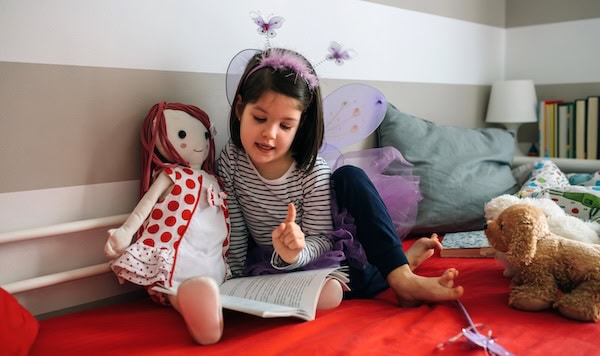
Reading aloud can be especially valuable when adults share books with children, with research linking shared reading to language and early literacy development.
Stories introduce children to worlds and sentence structures they may not encounter in everyday conversation. Regular shared reading also gives them experience of how stories work, how ideas connect across a page and how meaning develops from one part of a story to the next, helping to build language comprehension.
The most rewarding reading sessions often involve far more than simply reaching the final page. Pause to ask what they think will happen next. Talk about the illustration. Explain an unfamiliar word or let them finish a sentence themselves.
Those small conversations turn reading into something active rather than something children simply listen to.
There is an emotional side too; a bedtime story, a favourite picture book read for the hundredth time, or a chapter shared together on the sofa gives a child your attention as well as a story. Over time, books become associated with comfort, curiosity and time spent together.
Reading out loud is practice for speaking confidently
Public speaking involves far more than knowing what you want to say. Pace, emphasis, volume, and pauses all affect how somebody hears it. Toastmasters recommends practising aloud as a way to work on pace, projection, pronunciation, and pauses before a presentation.
Reading aloud lets you practice those skills without also having to think of what comes next. The words are already waiting on the page, leaving you free to concentrate on how you deliver them.
Try a passage of dialogue and notice where your voice naturally changes.
Read a speech and pay attention to where a pause makes the meaning clearer.
Or choose a paragraph from a favourite novel and see whether you instinctively speed up during an exciting scene.
Regular practise makes speaking at length feel more familiar, which can be useful before a presentation, reading, interview or any other occasion where nerves might otherwise encourage you to rush.
Sharing a story makes reading more social

Books have a reputation for being solitary, but reading aloud gives them a social side too.
Partners might take turns with chapters, friends can share poems or favourite passages, book groups can read sections together before discussing them. Hearing the same words spoken can bring out details, humour or emotion that each reader might have interpreted differently on the page.
There is something pleasantly old-fashioned about sitting down and simply listening to somebody tell you a story. It asks for attention in a way that scrolling, multitasking and half-watching something in the background rarely do.
Sometimes, hearing another person read a familiar passage also reveals a rhythm or feeling you had never noticed yourself.
Rediscover reading aloud
Most of us leave reading aloud behind once we become confident silent readers, but there is no reason it has to stay there.
Start small with a favourite passage, a few pages from your current book or a chapter shared with somebody else. Hearing the words beyond the page may reveal something about the writing, the story or even your own reading habits that you had not noticed before.
Sometimes, changing how you read is enough to make a familiar activity feel new again.
For more ideas and recommendations, explore the Victoria Freudenheim site for the latest book reviews and blog posts on reading culture.