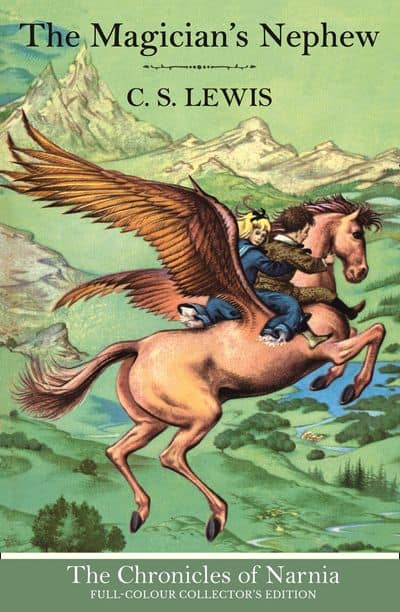
The Chronicles of Narnia: The Magician’s Nephew
C. S. Lewis
Most readers meet Narnia through a wardrobe. The Magician’s Nephew goes further back, to a pair of magic rings, two curious children and the events that bring both Narnia and one of its greatest threats into existence.
First published in May 1955, The Magician’s Nephew was the sixth of C. S. Lewis’s seven Narnia books to be released, although it now commonly appears first in chronological reading order.
More than 70 years later, there is a timely reason to return to it: Greta Gerwig (of Barbie fame) is bringing the story to the screen, with her Netflix adaptation due to be released in February 2027.
The story follows Digory Kirke and Polly Plummer, two children whose exploration of the attics connecting their London homes leads them into the study of Digory’s Uncle Andrew. He has been experimenting with magic rings capable of transporting people beyond their own reality and, rather conveniently, needs somebody else to test them.
From there, Lewis moves quickly. Digory and Polly discover the Wood Between the Worlds, where pools provide passage to other places, before arriving in the abandoned kingdom of Charn. It is here that Digory makes the decision that shapes much of what follows, awakening Queen Jadis and eventually bringing the future White Witch into the newly created Narnia.
“The Magician's Nephew, like the best of the Narnia books, does not drag its feet getting started. It takes a mere 30 pages to introduce all of the characters, establish a friendship, introduce us to a villain, and get both of the kids into another world.”
- – Eyrie.org
Charn is one of the book’s best creations. Empty halls, rows of long-dead rulers, and a dying sun give these chapters a surprisingly eerie atmosphere, while Jadis immediately feels dangerous. Lewis does not need long to establish what she is capable of before bringing her back to Edwardian London, where the tone abruptly becomes much funnier.
Uncle Andrew is central to that comedy. Vain, cowardly, and convinced of his own importance, he spends much of the adventure discovering that the forces he has been playing with are considerably beyond him. He is entertaining rather than especially complex, and that simplicity extends to several of the novel’s characters. Their moral qualities are rarely difficult to identify.
Digory has considerably more depth. His mother is seriously ill, and the possibility that magic could somehow save her sits behind his actions throughout the book. His curiosity causes genuine harm early in the story, giving his later decisions more weight when he is finally offered something he desperately wants.
Underneath the magic rings, talking animals and journeys between realities, The Magician’s Nephew is a story about grief, temptation and the consequences of acting before thinking. Digory is allowed to get things wrong, and those mistakes matter.
The creation of Narnia is another highlight. Aslan sings its landscape, stars, plants, and animals into existence, producing one of the strangest and most memorable sequences in the series. The Christian influence is especially clear during the later chapters. Creation, temptation, and forbidden fruit all have obvious biblical echoes, and Lewis rarely hides the moral framework behind the adventure. Younger readers can follow the story without understanding those references, although adult readers are unlikely to miss them.
“The style of this book is very much like a fairy tale written for children, which I like. It is a bit too simplistic for my taste at times, but it’s also great for older readers who want to take a break in between more complex narratives.”
- – Tigerpetal Press
At points, that certainty can make the book feel heavy-handed. Good and bad are generally easy to identify, and Lewis sometimes explains a lesson that the story has already made clear. His direct, conversational narration also belongs unmistakably to an older tradition of children’s fiction. For some readers, that gives the novel warmth; others may find its occasional asides and explanations dated.
There is also a lot packed into a relatively short book. The Wood Between the Worlds is such an intriguing idea that it feels almost underused, while Charn disappears shortly after becoming one of the book’s most interesting settings. Readers accustomed to modern fantasy novels that spend hundreds of pages developing their lore may be surprised by how readily Lewis moves on.
For anyone who has never ventured into Narnia before, deciding whether The Magician’s Nephew should be the first book you read isn’t straightforward. Chronologically, it makes perfect sense. As an introduction to the series, The Lion, the Witch and the Wardrobe still has the edge.
Some of the pleasure here comes from recognising how familiar pieces of Narnia came to exist. The lamppost, the White Witch, Professor Kirke and even the wardrobe itself gain extra meaning when you already know where they will eventually end up. Newcomers can follow it perfectly well, but returning readers are likely to enjoy those connections more.
Fans of classic children’s fantasy should find plenty to love, particularly the brisk adventure, odd humour and imaginative settings. Those looking for morally ambiguous characters, detailed world-building or a more subtle approach to allegory may find it comparatively slight. That does not diminish what the book does well, but it does make The Magician’s Nephew feel very much of its time.
“The animals’ treatment of Uncle Andrew was great fun, and I couldn’t resist laughing at Lewis’ dislike of school coming out once again.”
- – Literary Potpourri
It will soon face a very different audience. Greta Gerwig has written and directed a screen adaptation of the book. Netflix has confirmed it will open globally in cinemas on the 12th of February 2027, before arriving on Netflix on the 2nd of April. David McKenna and Beatrice Campbell lead a cast that includes Emma Mackey, Carey Mulligan, Ciarán Hinds, Daniel Craig, Meryl Streep, Kobna Holdbrook-Smith, Denise Gough, and Susan Wokoma.
Charn, the Wood Between the Worlds, and Narnia’s creation give Gerwig plenty to work with visually. The bigger challenge may be ensuring Digory’s relationship with his mother remains as important on screen as the spectacle surrounding it.
For anyone curious about Gerwig’s version, there’s still plenty of time to read Lewis’s story first.
Other works by C. S. Lewis
The Magician’s Nephew belongs to C. S. Lewis’s seven-book Chronicles of Narnia. Readers who want to experience the series in its original publication order can read the books as follows:
The Lion, the Witch and the Wardrobe (1950)
Prince Caspian (1951)
The Voyage of the Dawn Treader (1952)
The Silver Chair (1953)
The Horse and His Boy (1954)
The Magician’s Nephew (1955)
The Last Battle (1956)
Outside Narnia, Lewis also wrote works including The Screwtape Letters, Mere Christianity, and A Grief Observed.
Step into another world with Victoria Freudenheim
If The Magician’s Nephew leaves you looking for another world to disappear into, explore the Victoria Freudenheim archives. We’ve reviewed everything from fantasy epics and literary classics to contemporary bestsellers, with plenty more books waiting to be discovered.
Browse our latest reviews or visit our Top Rated collection to find your next read.
| ISBN | 978-0006716839 |
|---|---|
| Pages | 192 |