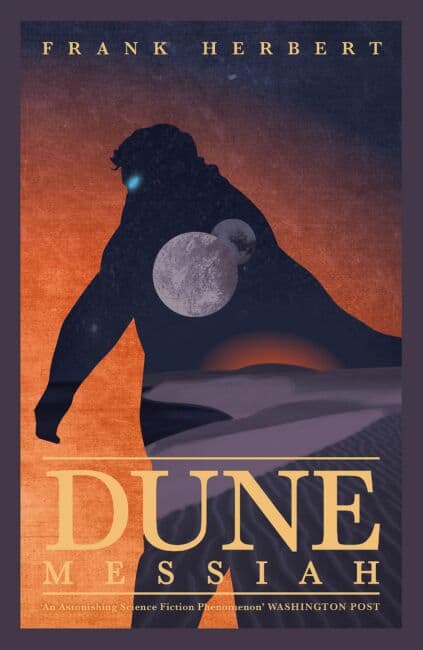
Dune Messiah
Frank Herbert
Spoiler Warning: This review discusses the ending of Dune and Dune: Part Two, but avoids major spoilers from Dune Messiah. You may want to read our review of Dune first.
Dune ends with Paul Atreides on the throne. Dune Messiah is where Frank Herbert starts dismantling the victory.
First published in 1969, four years after Dune, the second book in Herbert’s series returns to Arrakis after Paul has become Emperor. The young outsider who once fought alongside the Fremen now rules the empire built around his name, while a religious war carried out by his followers has spread far beyond the desert planet.
More than five decades later, there is a particularly good reason to return to the novel. Denis Villeneuve’s Dune: Part Three, which adapts Dune Messiah, is due to reach UK cinemas in December 2026.
Twelve years have passed since Paul defeated the Harkonnens and took the Imperial throne. He has almost unimaginable political power, the devotion of the Fremen, and the ability to see possible futures. None of it has brought him much freedom.
Enemies from several corners of the Imperium have begun plotting against him, while Paul is increasingly trapped by the consequences of his own decisions. Princess Irulan is his wife in name, but not in affection; Chani remains the person he loves, and even those closest to him have become pieces in political games that extend far beyond Arrakis.
“One thing that struck me immediately is that there’s more time here to spend getting invested in the characters.”
- – Alan K. Dell
There are fewer sweeping journeys across the desert and far less of the adventure that made Dune feel enormous. Much of the action here happens in conversations, private meetings, and attempts to work out who knows what. Herbert swaps the rise of a leader for the uncomfortable business of watching that leader live with what he has created.
Paul is considerably harder to admire this time around. He knows atrocities have been committed in his name and understands the danger of the religion built around him, yet knowing does not necessarily mean he can stop it. His ability to see the future, once one of his greatest advantages, increasingly feels like another form of confinement.
The more possibilities Paul can see, the fewer choices he seems able to make.
Herbert is particularly interested in the distance between having power and being free to use it. Paul can command an empire, yet every decision carries consequences he may have already foreseen. Trying to avoid one outcome can simply push him towards another.
The return of Duncan Idaho complicates matters further. He comes back not as the man Paul remembers, but as Hayt, a ghola created from Duncan’s remains by the Tleilaxu. His presence is both comforting and deeply suspicious, particularly when Paul knows that almost nothing offered to an emperor arrives without a motive attached.
“The advantage Dune Messiah has over Dune is that it’s considerably shorter. There’s no need to introduce the world since that’s already been done in Dune, so Herbert can get right to it and tell the story.”
- – Atticus Books
For readers expecting Dune again, this is where Messiah may prove frustrating.
The novel is much shorter, but it can feel denser. Herbert places enormous weight on political manoeuvring, philosophical exchanges and characters discussing futures that may or may not happen. The conspirators are introduced early, so the tension rarely comes from discovering who is behind the threat. It comes from watching Paul recognise pieces of the trap without knowing whether stepping around one part will simply move him towards another.
The result can be an oppressive sense of inevitability, although some conversations become so tangled in plans, visions, and hidden meanings that the characters begin to feel distant.
Chani helps pull the story back towards something more personal. Paul may be thinking about dynasties, religion, and the future of an empire, but his relationship with her gives those decisions an immediate cost. Their quieter scenes carry more weight precisely because so much of the world around them has become ceremonial and political.
It is difficult to imagine reading Dune Messiah without reading Dune first. This is not a sequel that patiently rebuilds the world for newcomers. Herbert assumes you understand Paul’s rise, the Fremen, the Bene Gesserit, and why the position he now occupies matters.
Readers arriving from Villeneuve’s films will have much of that foundation already, although the novels and films do not follow exactly the same path. Reading Dune first would still give Messiah more context, particularly around Paul’s transformation from ducal heir to religious figurehead.
“Dune Messiah works because it is open about being a tragedy. Gone is the boyish adventure of the original. Here there is only loss and suffering. It’s a quietly brutal book, and even if I don’t empathise with Paul, the agony he endures is undeniable.”
- – At Boundary's Edge
Villeneuve returns to direct Dune: Part Three. Timothée Chalamet and Zendaya reprise their roles as Paul and Chani, alongside Florence Pugh, Jason Momoa, Rebecca Ferguson, Anya Taylor-Joy, and Javier Bardem, while Robert Pattinson joins the cast as Scytale.
The adaptation has a different challenge this time around. Messiah is deliberately less interested in spectacle than Dune, with much of its tension coming from Paul’s thoughts, visions and conversations behind closed doors. How much of that survives alongside the scale expected of a Dune film could determine how closely Part Three resembles Herbert’s sequel.
For anyone planning to read it ahead of Dune: Part Three, that difference may be exactly what makes the book worth picking up first.
Other works by Frank Herbert
Dune Messiah is the second of Frank Herbert’s six original Dune novels. Readers continuing Paul’s story should read the series in publication order:
Dune (1965)
Dune Messiah (1969)
Children of Dune (1976)
God Emperor of Dune (1981)
Heretics of Dune (1984)
Chapterhouse: Dune (1985)
Herbert also wrote science-fiction novels outside the Dune universe, including The Dosadi Experiment (1977) and The White Plague (1982).
Not ready to leave Arrakis?
If Dune Messiah has you looking back at where Paul’s story began, read our review of Dune for our take on Herbert’s first novel and the world that set everything here in motion.
Or, if you’re ready to venture beyond Arrakis, browse our latest reviews, explore our top-rated books, or visit the Victoria Freudenheim blog for more reading recommendations and inspiration.
| ISBN | 978-1473655324 |
|---|---|
| Pages | 303 |