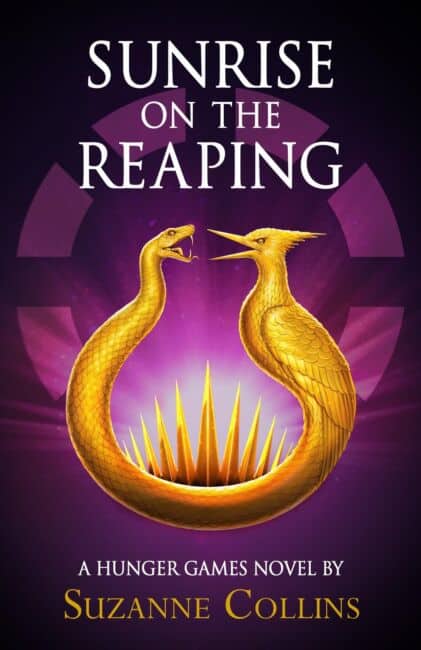
The Hunger Games: Sunrise On The Reaping
Suzanne Collins
Haymitch Abernathy is difficult to imagine as hopeful. By the time Katniss and Peeta meet him, he is caustic, alcoholic, and exhausted by years of mentoring children he expects to die. Sunrise On The Reaping returns to the sixteen-year-old he was before the Capitol stripped that hope away.
Published in March 2025, Suzanne Collins’ fifth Hunger Games novel takes place twenty-four years before the original trilogy. The Fiftieth Hunger Games is also the Second Quarter Quell, which means twice the usual number of tributes must be taken from every district. Haymitch is sent from District 12 alongside three other teenagers and into an arena built to turn their deaths into national entertainment.
The outcome is already known to anyone familiar with Catching Fire. Haymitch survives, outwits the arena, and pays for defying the Capitol. Collins uses that certainty well. The tension comes from watching the full story close around him and discovering how much of it Panem was never allowed to see.
Following a younger Haymitch is the novel’s great success. He is funny, observant, and far more open-hearted than the man he becomes, with a quick ability to spot danger and performance. His voice feels distinct from Katniss without losing the plain-spoken urgency that defines the series. However, that confidence can become arrogance, and his instinct to protect people sometimes leads him into decisions he cannot control.
“Collins is an excellent writer, and there are moments of surprising lyricism, which help to leaven the grimness.”
- The Guardian
Lenore Dove gives the opening chapters much of their warmth. Their relationship feels lived-in, and the Covey influence brings music, folklore and a little colour to District 12. Some of her dialogue carries more thematic weight than any teenager would comfortably bear, yet she remains a convincing part of Haymitch’s life.
Maysilee Donner is equally memorable. Proud, sharp, and frequently difficult, she resists becoming a simple ally of her rival. Her clashes with Haymitch give the District 12 group a useful edge, while her competence makes her fate hurt even when the destination is familiar.
The arena is brutal, inventive, and deliberately excessive. Forty-eight tributes create an immediate sense of waste, although the number also becomes one of the book’s weaknesses. Several competitors disappear too quickly to leave much impression, and the action occasionally races through deaths that deserve more room. Collins is strongest when she slows down and lets the psychological pressure settle.
This book is even more interested in what happens to the story of the Games once the Capitol controls it. Haymitch notices rehearsed interviews, selective footage, and the way a person can be turned into a character for public consumption. Collins has linked the novel’s ideas to David Hume and questions around political submission, yet the philosophy never overwhelms the plot. It emerges through what Haymitch sees being changed in front of him.
That gives the prequel a stronger purpose than simply explaining how another victor won. Sunrise On The Reaping shows that Katniss inherited a rebellion built through years of failed plans, forgotten sacrifices and suppressed stories.
“Sunrise on the Reaping is exactly what I expected it to be. I was intrigued from the start and just couldn’t stop reading.”
- Laurie Is Reading
The final section is the hardest to read and the most effective. Collins refuses to treat victory as an escape. Survival leaves Haymitch vulnerable to a government that can punish everyone around him, reshape the record and ensure his defence appears meaningless. The ending explains his later self-destruction while allowing the older Haymitch to remain complicated.
Sunrise On The Reaping covers familiar themes: spectacle, authoritarian power, child sacrifice, and the stories governments tell about violence. Haymitch’s perspective gives them fresh force, particularly when the novel turns to propaganda. The crowded cast and occasional overload of familiar names hold it back from matching the precision of The Hunger Games, but this is still one of the strongest additions to Panem.
New readers should begin with the original trilogy. This prequel depends on recognising the person Haymitch becomes and understanding which details have been hidden or distorted. Established fans will find a painful, purposeful return to the series, and a character study that earns its place alongside Katniss and Snow.
“Collins has managed to add so much more depth to the original trilogy with the addition of this prequel.”
- Bookworm Girl
It will be of no surprise to learn that The Hunger Games: Sunrise on the Reaping is already being turned into a film, currently scheduled to reach cinemas on 20 November 2026, after the immense success of the original trilogy. Francis Lawrence returns to direct, with Joseph Zada playing Haymitch, Whitney Peak as Lenore Dove, Mckenna Grace as Maysilee Donner, Elle Fanning as Effie Trinket, and Kieran Culkin as Caesar Flickerman. The wider cast includes Ralph Fiennes, Jesse Plemons, Maya Hawke, Glenn Close, and Lili Taylor.
The book’s focus on edited broadcasts and the manufactured public identities should suit the screen. The greater challenge will be preserving Haymitch’s internal voice beneath the scale and violence of the Quarter Quell.
Other works by Suzanne Collins
Although Sunrise on the Reaping is a prequel, much of its emotional impact depends on knowing Haymitch’s future and recognising the events that shape the original trilogy. New readers should therefore begin with Suzanne Collins’ earlier Hunger Games novels in publication order:
- The Hunger Games (2008)
- Catching Fire (2009)
- Mockingjay (2010)
- The Ballad of Songbirds and Snakes (2020)
Collins is also the author of The Underland Chronicles, a five-book fantasy series beginning with Gregor the Overlander (2003).
Find your next high-stakes read with our archives
If Sunrise on the Reaping leaves you wanting more stories shaped by power, survival and impossible choices, explore the Victoria Freudenheim archives. We’ve reviewed lots of books, from fantasy epics and literary classics to BookTok favourites and contemporary bestsellers, so there is plenty to discover beyond Panem.
Or, browse the latest reviews, view our top-rated recommendations, and get some bookish inspiration on the Victoria Freudenheim blog.
| ISBN | 978-0702349072 |
|---|---|
| Pages | 416 |