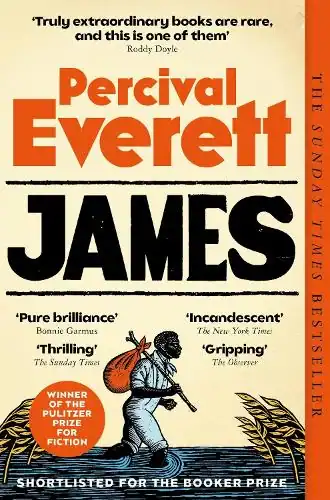
James
Percival Everett
Jim has spent more than a century travelling down the Mississippi beside Huckleberry Finn while somebody else tells the story. James gives him the pen.
Percival Everett’s 2024 novel returns to the world of Mark Twain’s Adventures of Huckleberry Finn, shifting the centre of gravity towards the enslaved man Huck knows as Jim. It is not a straightforward retelling. Everett takes familiar scenes and characters, then asks what they look like when the person facing the greatest danger is allowed to narrate them.
James went on to win the 2024 National Book Award for Fiction and the 2025 Pulitzer Prize for Fiction, as well as being shortlisted for the Booker Prize.
The story begins when Jim learns that Miss Watson intends to sell him to a man in New Orleans, separating him from his wife and daughter. He hides on Jackson Island while trying to decide what to do next. Huck has meanwhile faked his own death to escape his abusive father, and the two eventually begin their journey along the Mississippi.
Readers who know Huckleberry Finn will recognise plenty, from the raft and riverboats to the Duke and Dauphin. Yet Everett changes the meaning of those encounters simply by changing who understands the danger.
“Gripping, painful, funny, horrifying, this is multi-level entertainment, a consummate performance to the last.”
- – The Guardian
One of the most revealing differences between James and the version of Jim seen through Huck’s eyes is how carefully he controls what other people are allowed to see.
When white people are present, he adopts the speech expected of him. Among other enslaved people, that performance disappears, and even children understand that sounding too educated in the wrong company could be dangerous.
Everett gets plenty of humour from that gap, particularly when white characters hear exactly what they expect and never question it. Underneath the comedy is something much less comfortable.
James is constantly judging what he can safely reveal about himself, turning ordinary conversation into another part of surviving slavery. His private life also includes something the people around him would never imagine: books. James can read, and his imagined debates with thinkers including Voltaire and John Locke allow Everett to put abstract arguments about liberty beside the reality of a man who is legally treated as somebody else’s property.
This setup could make the novel feel like an academic exercise. It rarely does. Everett keeps James moving through escapes, scams and encounters that shift between absurdity and genuine horror. The humour never makes slavery feel less brutal. Instead, it gives James room to be witty and observant without making the danger surrounding him feel any less real.
That balance of momentum and reflection is much of the novel’s appeal.
“One of the noblest characters in American literature gets a novel worthy of him.”
- – Kirkus
James is frightened, angry, loving, calculating, and sometimes ruthless. His desire to return to his wife and daughter gives the journey urgency, but Everett refuses to make him simply noble. The further he travels, the more the careful performance expected of Jim begins to fall away.
The second half is less controlled than the first. As Everett moves further from Twain’s structure, the story becomes more openly violent and begins to resemble a revenge thriller. The pace sharpens, but some of the earlier subtlety around language and perception is lost. A late revelation may also divide readers familiar with Huckleberry Finn.
Even so, James never feels like a secondary character promoted for the sake of a clever premise. He feels as though he was always living a far more complicated story just beyond Huck’s understanding.
You do not need to have read Huckleberry Finn first. Everett gives enough context for James to stand alone, although familiarity with Twain makes the reversals and altered scenes more rewarding. It may even leave readers curious to return to the original afterwards and notice what Huck never sees.
“I found James' journey completely engrossing and came to really care about him and the multilayered connection he forms with Huck over the course of this magnificent story.”
- – Lonesome Reader
James is heading to the screen too. Universal Pictures acquired the feature-film rights, with Steven Spielberg executive producing through Amblin and Everett writing the screenplay and serving as an executive producer. Taika Waititi is attached to direct. There is no confirmed cast or release date yet, so the project remains at an early stage.
The film’s biggest challenge may be translating James’s inner voice to the screen. So much of the book’s humour and tension comes from the difference between what he thinks and what he chooses to say aloud, and losing that distinction could change the story considerably.
The fact that Everett is writing the screenplay himself makes that transition particularly interesting. Until more details emerge, though, the novel remains the best introduction to his version of James.
Other works by Percival Everett
Everett has been publishing for more than four decades. Readers looking for somewhere to go next could try:
Erasure (2001)
I Am Not Sidney Poitier (2009)
The Trees (2021)
Dr. No (2022)
Erasure was later adapted into the film American Fiction, while The Trees was shortlisted for the Booker Prize.
Find a new perspective with Victoria Freudenheim
If James has made you curious about fiction that rethinks familiar stories, explores history from a different viewpoint or places overlooked voices at its centre, keep exploring with Victoria Freudenheim. Explore our latest reviews, browse our top-rated books, or head to the Victoria Freudenheim blog for reading lists, recommendations and more ideas for what to pick up next.
| ISBN | 978-1035031269 |
|---|---|
| Pages | 320 |